

Future Farm Investment Scheme (FFIS 2026) – Round 2
28 October 2026
Further guidance has been published regarding the upcoming FFIS round including the total funding available per claimant, and how the scheme will be scored.
Who is eligible?
A business may qualify if it has an active BRN and submitted a SAF by 15 May 2026, or claimed support from at least one of the schemes listed in the guidance, and is actively undertaking agricultural activity.
If the business claimed BPS, it must also have declared at least two qualifying Whole Farm Plan audits or plans on its 2026 SAF.
There will be no priority groups such as young entrants or small holdings this round.
What is eligible?
There are 74 options being funded under this round – more may be added towards the scheme opening date, we have seen two options added this week alone. These options are grouped under seven overarching headings (Full list at Appendix 1):
- Grazing and Grassland Management
- Soil Health & Reduced Cultivation
- Precision Farming Crop & Grassland Management
- Slurry Management
- Energy & Resource Efficiency
- Livestock Management & Animal Health
- Environmental Land Management & Protection
The detailed guidance describes what will be funded under each eligible item, making it clear from the offset what will and will not be funded.
Compared with Round 1, the list of eligible items is reduced, for example only mobile handling systems are funded this round, and Boreholes which were a popular choice in round 1 are no longer available. This prescription however does provide more clarity than the vague list we had previously.
How much can I apply for?
The maximum funding anyone can apply for is £20,000 – the cap based on holding size has been removed, therefore every eligible applicant can apply for up to £20,000 in total.
The majority of applicants can only apply for a grant rate of 50% of the cost of their item, therefore if an item costs £25,000, they can apply for £12,500.
There are some exceptions to this rule:
- New Entrants can apply for a higher grant rate of 80% of the total cost (up to £20,000). New entrants are new to farming and have submitted their first BPS since 2021. This does not include an existing business that has had internal changes to structure or business partners.
- Eligible items under the ‘Environmental Land Management & Protection’ category have a grant rate of 100%, however as the majority of these options are standard costs matching the AECS rates, in real terms the rates for many are closer to 50-60% of actual costs. Many of these items are also capped e.g. hedge planting is a maximum of 500 linear meters however such an option could help enhance EFA options by reducing hedge gaps.
Maximum Total Cost / Total Eligible Cost
As with the first round, claimants are strongly advised to gain quotes for the items being applied for. The Scottish Government has declared a Maximum Cost per item, of what they believe 100% maximum cost should be. As a result, the most that can be applied for towards an item is 50% of the maximum cost, regardless of whether your quotation is higher.
If however, you can source your item cheaper, you can only apply for 50% of this lower amount. The lesser of the two is the Total Eligible Cost
As with round 1, once purchased and item received, successful applicants will need to provide invoices and bank statements to show the total amount paid, and recoveries made for any over funding.
Ranking / Scoring
Each item has been scored by the Scot Gov, as shown in Appendix 1. This helps to rank the priority of the items. Eligible applications will be ranked by Application Score and funding will be allocated in ranking order, working down the list until the budget is spent. Scores will be looked at to 4 decimal places.
If an applicant submits a claim for one item, then the Score at Appendix 1 which uses the Maximum Cost, is given to that item, regardless of whether they can source the item cheaper. The Grant however will be fixed to 50% of the Eligible (cheapest) Cost.
If an applicant applies for more than one item, then the Eligible (Cheapest) Cost is used to help calculate the combined score. Depending on the items being applied for, if one or more item has a low ranked score, this could pull the overall score considerably lower than the highest scored item being applied for. Thought should be given therefore as to whether it is worth negatively impacting a score – and reducing the chances of successfully gaining funding, to ask for the full list of items. This must therefore be considered on a case-by-case basis.
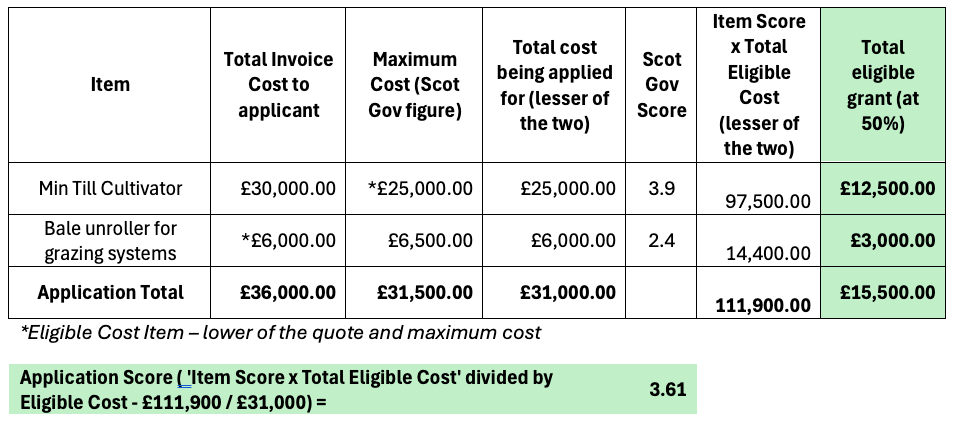
In the worked example below, applicant applies for funding towards a Min Till cultivator at £30,000 (£5k higher than the maximum cost) and a Bale unroller at £6,000 (slightly under the £6,500 maximum cost):
Can only apply for 50% of the Eligible Cost (lesser rate) so £25,000 (Maximum Cost) for the cultivator and can only apply for £3,000 towards the bale unroller (Eligible Cost), therefore the total grant applicable would be £15,500, but the total investment by the business would be £36,000.
Considerations
- Some items may have a detrimental impact on the success of your application, for example, applying for hedge planting (which is highly ranked), along with fencing, which is ranked low would give a lower overall score for your application. It may be worth sacrificing some elements such as paying for fencing at your own cost, to strengthen the rest of the application.
- Some items such as those listed under the Environmental category could be used to help the business meet their EFA requirements e.g. gapping up hedgerows, individual tree planting for Agroforestry options on BPS eligible ground.
- If an item is of interest, it is worth reading the detailed guidance on the specification required for eligibility.
- It is also worth considering delivery/establishment windows – for environmental options can you achieve this in the limited planting window available during this round?
- All items applied for must be paid for by the business bank account that the BPS payment is received into;
- You cannot pay the balance by Hire Purchase agreements;
- Get quotations for the items you wish to apply for in advance of the round opening (you won’t need to submit these but will be held to these figures);
- You cannot purchase the item without first signing an FFIS contract;
- Those in receipt of FFIS funds will have all future payments – BPS/AECS/SSBSS etc withheld until their evidence is approved. Round 2 is likely to be 2/3 months later than Round 1, which saw claimants receiving funds up to 7 weeks after payments commenced. Round 2 could therefore see BPS payments being withheld into the new year if similar delays in processing evidence occur;
Further information on when this round will open will be announced in November, therefore we would anticipate a late November opening. Round 1 had an 8-week application window, therefore submissions perhaps by the end of January, with successful applicants receiving funds perhaps March. All of this will be confirmed in due course but is worth considering prior to applying.
Should you have any queries, please contact our Rural Payments Team – Jenni Douglas & Rowan Henderson on 01573 224 381
If you would like to receive updates about the FFIS and other grant and subsidy schemes direct to your inbox, sign up here – http://eepurl.com/hzGntD